Reports of Parandalia ocularis and Parandalia fauveli are occasionally made from western Mexico to Alaska in the eastern Pacific. Both names are used in Southern and Central California. Typical separation between these taxa is based upon the presence or absence of subdermal eyes (figure #1).
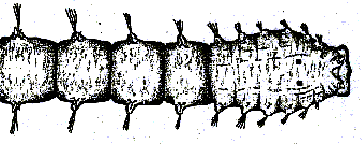
However, dissected specimens reveal these "eyes" are nerve ganglia associated with the brain. The presence of "eyes" is often difficult to detect in undissected specimens as these subdermal ganglia may not be dark enough to view through the skin. In specimens recorded as lacking "eyes", reexamination by dissection or careful squeezing and rolling of the specimen will reveal the ganglia.
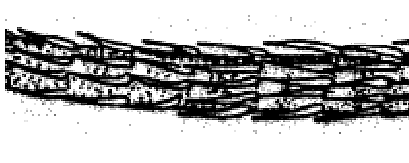
Another reported difference between these species is the number of neurosetae in posterior fascicles. P. ocularis is described as having seven setae, while P. fauveli has up to 16 setae. A circlet of fine barbs covers these setae (figure#2). Close observation and manipulation of these setae demonstrate that many setae will lock into each other along their entire length. When locked together, two such setae will appear as one. The result is likely to be an undercount of the number of setae in the fascicle. It is not uncommon for specimens with "eyes" (ocularis condition) to also possess up to 16 neurosetae (fauveli condition).
These two previous diagnostic characters do not adequately separate the taxa.
Both species have thick and stout anterior notospines. The P. ocularis notospines begin on setiger nine , while P. fauveli begin on setiger seven. These spines are thick but are crystalline or nearly clear in appearance and difficult to see when emergent from the body wall. Non-emergent notospines or those broken at the dermis level are extremely difficult to detect. The initial notospine appearance is not a reliable diagnostic character.
Emerson and Fauchald (1971) note that P. ocularis possesses a tube, stating: "...sections of an annulated skelopodium (chitinized secretion) cover some of the posterior segments...". Several specimens collected by the LACSD marine biology laboratory are in delicate clear tubes (see holotype condition below). At least one LACSD specimen (RV0791-1D4) is almost entirely within this clear tube. The tube walls are clear, delicate, and with weak wrinkles but no annulations. This condition is not diagnostic for P. ocularis due to the presence of a previously undescribed tube on the holotype of P. fauveli.
The holotype of Parandalia fauveli (USNM 32891) has been reexamined. It is a specimen about 80mm in length and 0.9mm in width. It is broken into three pieces and is strongly curled. The prostomium has previously been dissected through the first 8-9 segments. The third parapodia has been removed on one side. The middle segments of the specimen are encased in a closely adhering chitinous tube. There are some weak annulations or wrinkles on this tube. The tube is broken apart at these locations. The epidermis is light greenish-yellow. It is flecked with reddish iridescence. This iridescence is not visible when viewed only with substage light. There are no dark "eyes" apparent either dorsally, ventrally, or viewed through dissection cut. It does have two bulbous structures in the head region on either side of pharynx. Though not darkly pigmented, these structures resemble the "eyes" of P. ocularis. One bulb is larger, while the other appears to be partly cut away and is considerably smaller. These possibly are nerve tissue or ganglia that could be interpreted as "eyes" on other specimens. First crystalline notospines begin on segment eight. Setal fascicles possess up to at least 12 neurosetae in each parapodia. Setae are closely held together along their length so that shafts appear as a single structure. When viewed and manipulated under the compound scope, they can be seen as two setae.
There are published descriptions and keys for these two species (Emerson and Fauchald 1971, and Salazar-Vallejo 1990). Each emphasizes the "eyed" condition and/or the neurosetal count. Unfortunately the type material used to erect the species P. ocularis has not been found. The absence of "eyes" is typically missed as these are nerve ganglia which may lack pigmentation in some specimens and are often difficult to see through the thick dermis. Specimens have been collected that clearly have "eyes", but possess up to 16 neurosetae and therefore share characters described as unique for each of the two species. The species P. ocularis is apparently based on an incorrect diagnosis of "eyes" and a miscount of neurosetae. It is recommended that the name Parandalia ocularis be synonymized to Parandalia fauveli.